A turnkey online shop in Telegram: product catalogue and basket
A priced catalogue, a basket and order taking — right inside the chat the customer already opens ten times a day. There is no app to install and no registration: tap a button, place an order.
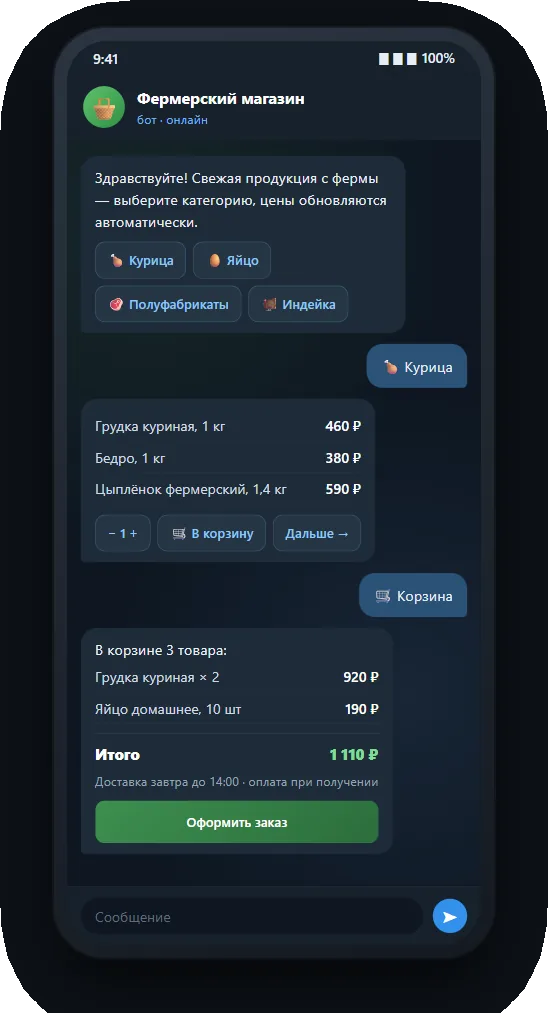
The shop lives inside Telegram and behaves like an ordinary conversation. A person opens a category, sees the current price, fills a basket and confirms the order — with no jump to a website, no registration and no long forms. At that moment the seller receives a notification with the order contents and the customer's contact details.
🛒 Catalogue and basket
Categories, product cards, quantities, a running total. The basket is saved — the customer comes back and carries on where they left off.
🔔 Orders and notifications
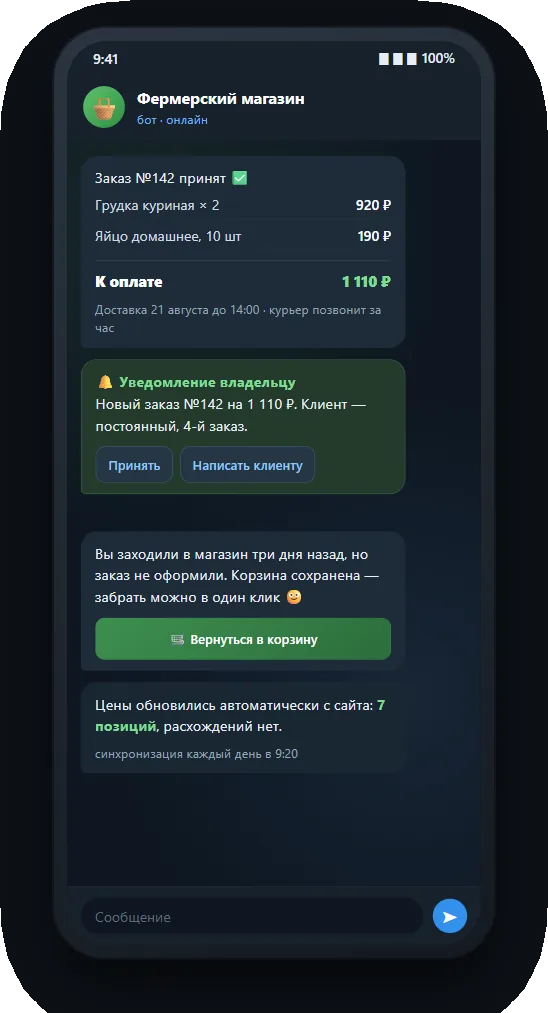
A placed order reaches the owner in Telegram with the full contents, the total and the contact details. You can reply to the customer from there in one tap.
🔄 Prices from your website
If a website already exists, the bot takes prices from its product feed and updates them itself. There is no more editing the price list by hand in two places.
💬 Bringing the customer back
Someone looked around and got distracted — a few days later the bot reminds them about the saved basket. Gently, in one message, with a button to return.
An example from real practice
A farm produce shop: meat, poultry, eggs, prepared foods. Before the bot, orders were collected in private messages and over the phone, while prices lived separately on the website and in the chat — and drifted apart. We built a Telegram shop where the catalogue, the basket and checkout all sit in one conversation.
The customer picks a category, fills the basket and sees the total with a delivery date.Three mechanics put in one frame for clarity: order confirmation, the owner's notification and the abandoned-basket reminder.
What we built in this project
A catalogue by categoryProducts, prices, pack weight — the customer sees the same as on the website.
Basket and checkoutQuantity, total, delivery date, payment method.
Price synchronisation with the websiteThe bot checks the price list against the site's product feed daily and flags discrepancies before a customer notices them.
Saved-basket reminderThree days after the first visit — one message with a button to come back.
Server and autostartThe bot runs on a server, restarts itself after a reboot and does not depend on anybody's home computer.
Daily database backupA copy of orders and customers is made every night and stored separately from the server.
What it costs
Turnkey shop
Catalogue, basket, checkout, notifications to the owner. Suits a range of up to a few dozen products.
from ₽5,000 (≈ $59)
Shop plus prices from your website
The same, plus automatic synchronisation of the catalogue and prices with your website and a daily check.
from ₽8,000 (≈ $95)
Deployment on your server
We deploy the bot on your own platform, set up autostart and backups, and hand over the credentials with a short guide.
+ 1 500 ₽
Improvements after launch
New sections, promo codes, online payment, exporting orders to a spreadsheet — quoted separately per task.
from ₽2,500 (≈ $30)
The bot stays yours
The bot is registered on your account and runs on your hosting — the credentials and the order database stay with you. We hand over the code and restart instructions and remain available for further work. Timelines: a basic shop takes 3–5 days, one with catalogue synchronisation up to a week, counted from the moment the product list is agreed.
Tell us what you sell and whether you have a website — we will quote and name a deadline the same day.
Building the product catalogue is the main part of the work on a messenger shop: categories, cards, prices, photographs, availability. The cost depends on the number of items and on where the data comes from — a spreadsheet, a website, or manual entry.
We hand over a turnkey Telegram shop ready to sell: the catalogue is filled, the basket adds up, and the order reaches the owner in a chat instead of getting lost in comments. Catalogue synchronisation with your website is set up separately, so prices never have to be edited twice.
What it costs and what is included
A Telegram shop starts from ₽5,000 (≈ $59). The basic build includes a catalogue by category, product cards with prices, a basket, checkout and a notification to the owner with the contents and the customer's contact details. That is enough to start taking orders, not merely to display goods.
Priced separately are the things not everyone needs: price synchronisation with a website, online payment, abandoned-basket reminders, exporting orders to a spreadsheet or a CRM. We quote each item before the work starts — and never add them to the invoice silently because “it would be more convenient this way”.
How the work runs
Understanding the task. You tell us what you sell and how you take orders now. We say what is worth automating and what is better left as it is.
Estimate and deadline. We fix the scope and the price before starting. A simple shop takes from five days; one with payment and synchronisation takes longer, and we name a specific date.
Building and showing. We build the shop and show you a live bot, not pictures. Changes to it are free — that is part of the job.
Handover. We register the bot on your account, deploy it on your side and hand over the credentials with restart instructions.
Why a shop and not a website
It is not that a website is worse. It is the customer's path: to buy on a website, a person has to follow a link, wait for it to load, work out the menu and fill in a form. They are already inside the messenger — they open it several times a day — and an order takes them three taps.
The other side of it: a Telegram shop does not replace a website if search rankings matter to you. Search engines do not index a bot; the customer reaches it through your link — from an advert, a business card, the website itself or your channel. It works best as a pair, and we say so up front rather than after launch.
Who it suits
A messenger shop fits a small range with repeat purchases: farm produce, baked goods, flowers, coffee, handmade items, food delivery. Where the customer comes back regularly, the saving on each order adds up to a noticeable difference. If you have thousands of items with complex filters, we will say plainly that a full website with a catalogue is more convenient, and offer that instead of a bot.
Frequently asked questions
What does a shop cost and what drives the price?
From ₽5,000 (≈ $59) for the basic build: catalogue, product cards, basket, checkout and a notification to the owner. It costs more when you need online payment, price synchronisation with a website, abandoned-basket reminders or exporting orders to a CRM. We name the exact figure before starting.
Do I need a registered business and an online till?
If you take payment on delivery or by transfer, launching the shop does not require it — the bot simply collects orders. As soon as payments are accepted inside the bot, tills and receipts become mandatory, and we warn about that in advance. We can point you in the right direction, but questions like these are best settled with your own accountant.
Who fills the catalogue with products?
If you have a website with a product feed, the bot takes products and prices from it and updates them itself — nothing has to be entered by hand. If there is no website, we do the initial fill from your list, and after that you add products through a simple admin panel without us.
Will the bot run on your server?
No — on yours. We register the bot on your account, deploy it on your side and hand over the credentials with restart instructions. That way the shop does not depend on us: it keeps running even if we stop working together. You pay the hosting provider directly; it does not appear in our estimate.
What happens if the bot breaks?
Small fixes after delivery are free. The bot is deployed with autostart: after a server reboot it comes back by itself and does not depend on anybody's computer being switched on. If serious work is needed for new requirements, we quote by volume and agree it in advance.
I already have a website. Will a Telegram shop replace it?
It will not, and we will not promise otherwise. A bot is invisible in search: the customer reaches it through your link — from an advert, a channel, a business card or the website itself. The best arrangement is a pair: the website brings new people in from search, while the bot keeps the regulars and turns a repeat order into three taps.